Table of Contents
- How to Identify Your Nose Shape
- Side Profile Clues
- Photo and camera checks before you choose a nose type
- Key Nose Anatomy: What to Look For
- The 8 Nose Shape Types Explained
- Nose Shapes, Genetics & Ethnicity
- Makeup Contouring Tips by Nose Type
- Glasses Frames for Your Nose Shape
- Use AI to Detect Your Nose Shape
- Frequently Asked Questions
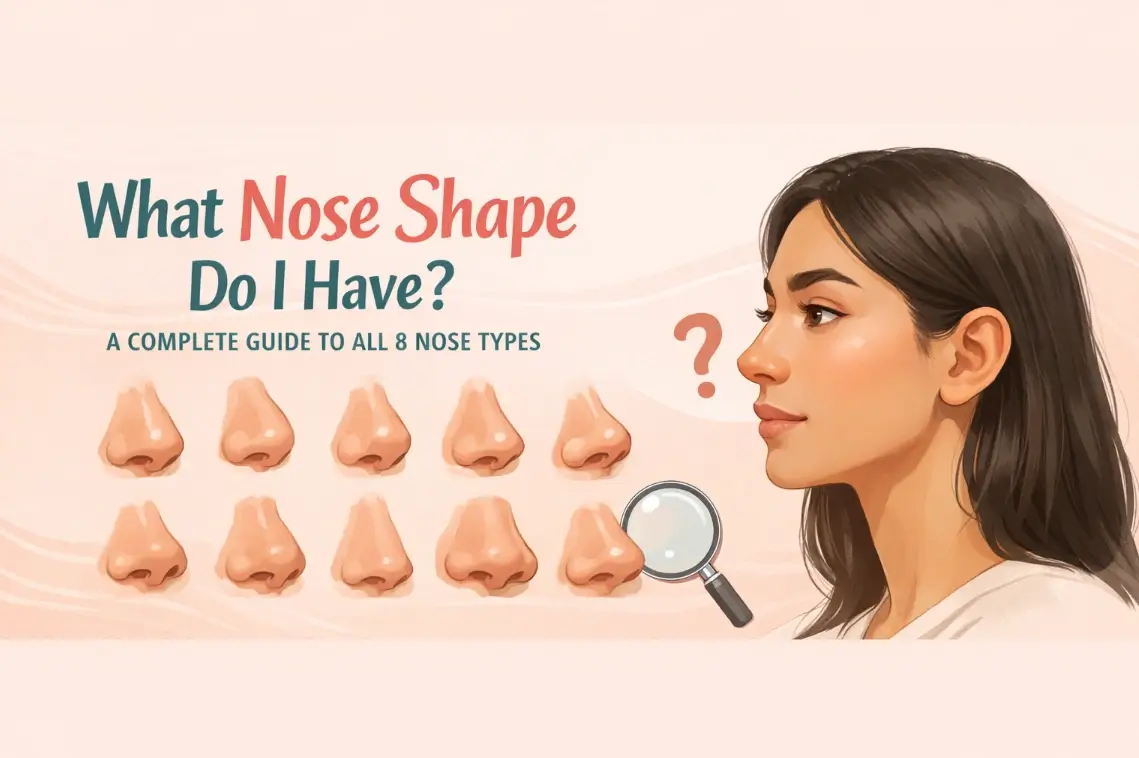
"What nose shape do I have?" It's one of those questions that sounds simple until you're actually standing in front of a mirror trying to figure it out. Is that a bump on your bridge a Roman nose or an aquiline one? Is your small, upturned tip a button nose or a snub nose? The difference matters — not for vanity, but because knowing your nose type helps you contour more effectively, choose better-fitting glasses, and simply understand your own face a little better. In this guide, I'll walk you through all 8 nose shapes recognized by our AI detector, explain the anatomy behind each one, and give you practical tips you can actually use. If you landed here from searches like nose shapes, nose types, celestial nose, snub nose shape, or nose identifier, start with the quick comparison below before reading the detailed guide.
Quick Nose Shape Identifier: Match the Main Clue First
Most nose shape searches become easier when you match the most visible clue first. Use this quick table before deciding whether your nose is straight, roman, aquiline, button, celestial, snub, bulbous, flat, or nubian.
| Search clue | Likely nose shape | What to check next |
|---|---|---|
| Straight bridge with balanced tip | Straight or Greek nose | Confirm that the side profile has no dorsal hump. |
| Prominent bridge bump or convex profile | Roman nose | Compare with aquiline nose: Roman is usually bolder and more abrupt. |
| Long smooth curve from bridge to tip | Aquiline nose | Look for a graceful arc rather than a sharp bump. |
| Small rounded tip | Button or celestial nose | Button is compact; celestial often has a softer upward rotation. |
| Short nose with nostrils visible from front | Snub nose shape | Check whether the tip tilts upward clearly. |
| Wide rounded tip | Bulbous nose | Focus on tip fullness rather than bridge height. |
| Low bridge and wider base | Flat or nubian nose | Flat has lower projection; nubian often has a longer bridge with a broad base. |
Photos from a distance are more reliable than close selfies. A wide-angle phone camera can make the nose look larger and change the apparent shape.
Still unsure whether your nose is a snub nose?
Use our dedicated snub nose shape guide to compare tip rotation, nostril visibility, and the button-nose overlap before you classify your profile.
Read the snub nose guideSide Profile Clues: Convex, Concave, Low-Bridge, and Straight Noses
A side profile often answers the question faster than a front-facing selfie. Use these bridge clues when searches such as convex nose, low bridge nose, human nose profile, or concave nose shape brought you here.
| Profile clue | Likely match | How to confirm |
|---|---|---|
| Convex bridge with a noticeable bump | Roman nose or aquiline nose | Roman is usually shorter and bolder; aquiline is longer with a smoother arc. |
| Concave bridge with an upward tip | Snub nose or celestial/button overlap | Check whether the nostrils are visible from the front and whether the tip rotates upward. |
| Low bridge with broad nostril base | Flat nose or nubian nose | Flat noses sit closer to the face plane; nubian noses often keep a longer bridge with a wider base. |
| Straight bridge with balanced projection | Straight or Greek nose | Confirm that the side profile has no dorsal hump and the tip is neutral. |
Do not judge from a close phone selfie alone. A wide-angle lens can exaggerate projection and make a balanced nose look more convex.
Photo and camera checks before you choose a nose type
Many searches for nose shape diagnosis come from people comparing a mirror view with a phone photo. Use this quick check before deciding whether your nose is straight, button, celestial, snub, or aquiline.
| Photo clue | What it can distort | Better check |
|---|---|---|
| Close selfie makes the center of the face look larger | Nose width and projection can look stronger than they are | Take one photo from farther away or use a mirror-distance portrait |
| Only a front photo is available | Bridge curve and convex profiles are hard to judge | Add one side-profile photo before choosing roman, aquiline, or straight |
| Nostrils look very visible | A low camera angle can exaggerate an upturned or snub impression | Retake at eye level and compare the tip rotation |
| Small rounded tip with slight lift | Button nose and celestial nose can overlap | Use nostril visibility and bridge length as the deciding clues |
For a second check, use the AI detector with a clear front photo, then compare the result with this guide instead of relying on one distorted selfie.
Compare with the face shape calculatorHow to Identify Your Nose Shape
Identifying your nose shape comes down to examining three key structural elements: the bridge, the tip, and the nostrils. Here's a simple 3-step method you can do right now with just a mirror.
Look at your bridge from the side
Is it perfectly straight with no bumps? Slightly curved or arched? Does it have a noticeable hump or hook? The bridge profile is the single most distinguishing feature between nose types.
Examine your tip from the front and side
Is your tip rounded and compact, or wide and fleshy? Does it point upward, straight ahead, or slightly downward? The tip direction and size narrow down your type significantly.
Check your nostrils
Are they narrow and close-set, or wide and flared? Are they visible from the front when you look straight ahead? Nostril width and visibility help distinguish flat, nubian, and snub noses from others.
Pro Tip
For the most accurate self-assessment, take a photo in natural light — one straight-on and one from the side. Photos reveal structural details that are easy to miss in a mirror.
Key Nose Anatomy: What to Look For
Before diving into the 8 types, it helps to know the five anatomical elements that define every nose shape. These are the same landmarks our AI analyzes when detecting your nose type.
| Anatomical Element | What It Means |
|---|---|
| Nasal Bridge | The upper bony portion connecting your nose to your forehead. Can be high, low, straight, convex (arched outward), or concave (curved inward). |
| Nasal Tip | The lower soft-tissue end of the nose. Varies in size (small to bulbous), shape (pointed to rounded), and direction (upturned, neutral, or downturned). |
| Nostrils | The two openings at the base. Characterized by width (narrow to wide), shape (round, oval, or flared), and visibility from the front. |
| Nasal Length | The distance from the bridge root to the tip. Shorter noses tend to look more youthful; longer noses create a more defined, mature profile. |
| Nasal Projection | How far the nose extends outward from the face plane. High projection creates a prominent profile; low projection gives a flatter appearance. |
The 8 Nose Shape Types Explained
These are the 8 nose types identified by our AI nose shape detector. Each description covers the key structural traits, how to recognize it, and which famous faces share the type.
8 Nose Types at a Glance
| Nose Type | Bridge | Tip | Nostrils | Common In |
|---|---|---|---|---|
| Straight (Greek) | Perfectly straight | Proportionate, neutral | Moderate width | All ethnicities |
| Roman | Convex hump | Slightly downturned | Moderate | Mediterranean, Middle East |
| Aquiline | Long curved arch | Slight downward lean | Moderate | European, Native American |
| Button | Low to moderate | Small, rounded | Proportionate | East Asian, global |
| Snub | Short, concave | Upturned (>115°) | Visible from front | Global, common in children |
| Bulbous | Varies | Wide, rounded, fleshy | Moderate to wide | All ethnicities (~25% globally) |
| Flat | Very low | Moderate, neutral | Wide | East/SE Asian, African |
| Nubian | Long, moderate | Downward or neutral | Wide base | West African, African-American |
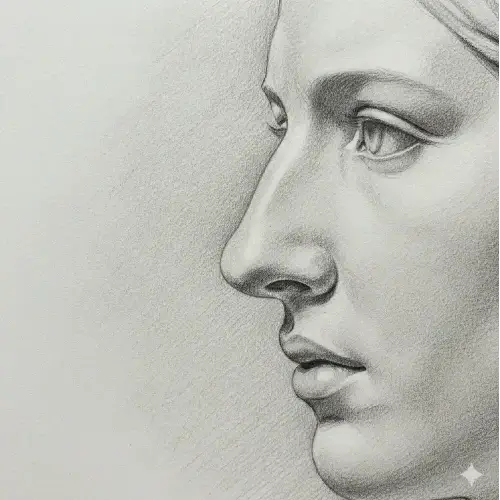
Straight Nose / Greek Nose
The straight nose features a perfectly even bridge line from root to tip — no bumps, no curves, no arches. The profile is clean and symmetrical, which is why it's also called the Greek nose, a reference to the idealized proportions seen in ancient Greek sculpture.
From the side, your bridge runs in a straight, uninterrupted line. The tip is proportionate and neither dramatically upturned nor downturned.
One of the most common nose shapes globally, appearing across all ethnicities.
Famous faces: Natalie Portman, Ryan Gosling
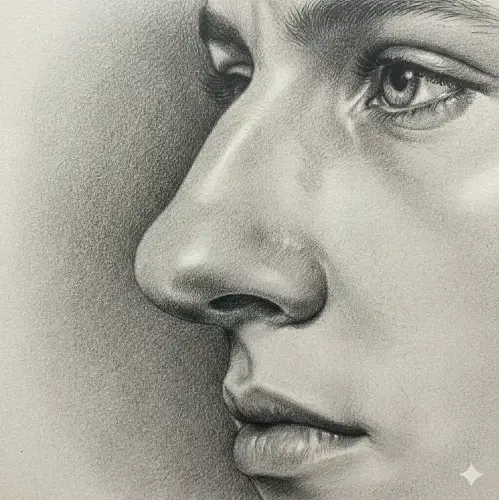
Roman Nose / Aquiline-adjacent
The Roman nose has a prominent, convex bridge — it arches outward before descending toward the tip. The tip itself may point slightly downward or remain neutral. It creates a strong, defined profile that has historically been associated with authority and leadership.
From the side, your bridge has a noticeable outward curve or hump. The overall nose appears bold and angular.
Common in Mediterranean, Middle Eastern, and South Asian populations.
Famous faces: Barbra Streisand, Daniel Craig

Aquiline Nose / Eagle Nose
From the Latin word for eagle (aquila), the aquiline nose features a long, curved bridge with a graceful, sweeping arch. Unlike the Roman nose, the curve is more elongated and elegant rather than abrupt. The tip may have a slight downward lean but doesn't hook sharply.
Your bridge has a long, flowing curve — more like a gentle arc than a sharp bump. The nose appears prominent and sculptural from the side.
Found across many ethnicities; historically associated with aristocratic European and Native American facial features.
Famous faces: Meryl Streep, Adrien Brody
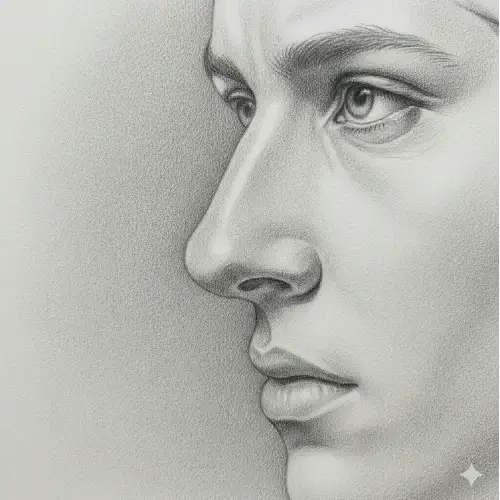
Button Nose / Celestial Nose
The button nose is small, compact, and rounded — the kind of nose that gives a face an instantly approachable, youthful quality. The bridge is low to moderate, the tip is gently rounded, and the overall structure is petite without being dramatically upturned.
Your nose is small and neat. The tip is rounded and sits close to the face. From the side, the profile is soft with no strong angles.
Common across East Asian populations and frequently requested in rhinoplasty consultations worldwide.
Famous faces: Scarlett Johansson, Zac Efron
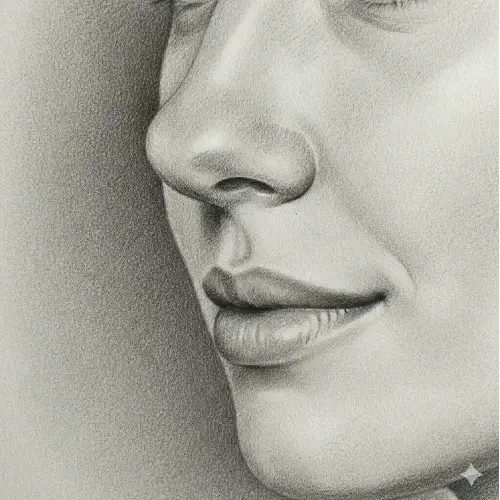
Snub Nose / Upturned Nose
The snub nose shares the compact size of the button nose but with a more pronounced upward tilt. The nasolabial angle (the angle between the upper lip and the nose) typically exceeds 115 degrees, making the nostrils more visible from the front. The bridge is short and often slightly concave.
Your nose tip points noticeably upward. When someone looks at you straight on, they can see your nostrils. The bridge is short.
More common in children; some adults retain this shape into adulthood.
Famous faces: Emma Stone, Carey Mulligan
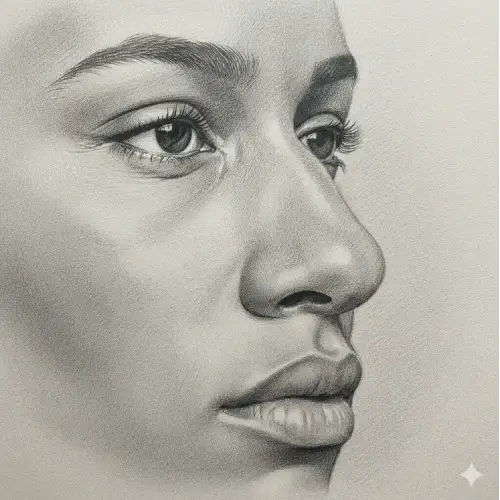
Bulbous Nose / Fleshy Nose
The bulbous nose is defined by a wide, rounded, fleshy tip that appears larger than the bridge. The soft tissue at the lower nose is fuller and more prominent. Skin thickness plays a significant role — thicker skin amplifies the rounded appearance. This is actually one of the most common nose shapes in the world.
Your nose tip appears wide and rounded, noticeably fuller than the bridge. The lower nose looks soft and substantial.
Approximately 25% of the global population has this nose type — it's the most common shape worldwide.
Famous faces: Bill Murray, Leo Tolstoy
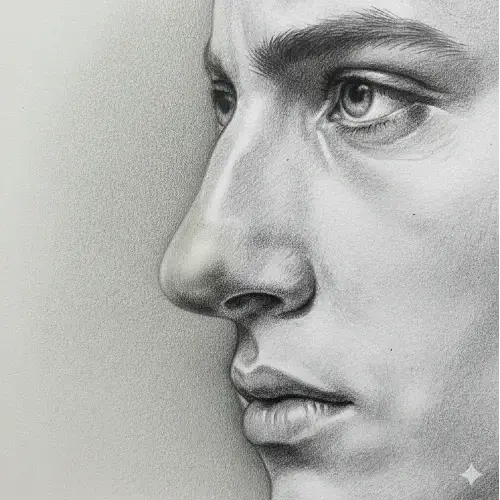
Flat Nose / Low-Bridge Nose
The flat nose has a very low nasal bridge, giving the nose a flatter, wider appearance from the front. The nostrils tend to be broader, and the nose sits closer to the face plane. This is a genetic variation — not a structural irregularity — that reflects adaptation to specific climates over thousands of years.
From the side, your nose has minimal projection from your face. The bridge is low and the nose appears wider from the front.
Common in East Asian, Southeast Asian, and sub-Saharan African populations.
Famous faces: Lucy Liu, Naomi Osaka
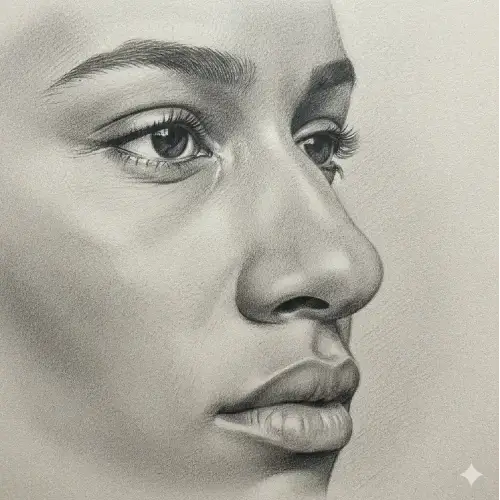
Nubian Nose / Wide-Base Nose
The Nubian nose features a longer bridge paired with a wider nostril base. The tip tends to project downward or straight ahead, and the lower nose appears fuller due to the broader alar base. It creates a strong, prominent facial presence.
Your nose has a longer bridge and noticeably wider nostrils. The base of your nose is broader than the bridge.
Common in West African and African-American populations, but found across many ethnic backgrounds globally.
Famous faces: Lupita Nyong'o, Idris Elba
Nose Shapes, Genetics & Ethnicity
Your nose shape is primarily determined by genetics — but it's also shaped by thousands of years of climate adaptation. Research published in PLOS Genetics found that nostril width is significantly influenced by local climate: populations from cold, dry climates tend to have narrower nostrils (which warm and humidify air more efficiently), while those from warm, humid climates tend to have wider nostrils.
- Nasal bridge height, tip shape, and nostril width are all heritable traits influenced by multiple genes
- Climate adaptation explains much of the variation in nostril width across global populations
- No nose shape is more or less "ideal" — each reflects a different evolutionary and genetic heritage
- Mixed-heritage individuals often display combinations of traits from multiple nose type categories
A Note on Diversity
Understanding the genetic and cultural context of nose shapes is important for appreciating natural human diversity — and for recognizing that beauty standards are culturally constructed, not universal.
Source: Adhikari et al. (2016), Nature Communications — genome-wide association scan of human facial variation .
Makeup Contouring Tips by Nose Type
Contouring is about using light and shadow to create the illusion of different proportions. Here's how to approach it for each nose type. You'll need a matte contour shade (2 shades darker than your skin) and a highlighter.
Contouring Quick Reference
| Nose Type | Contour Placement | Highlight Placement | Goal |
|---|---|---|---|
| Straight | Minimal — sides only if desired | Center bridge line | Maintain balance |
| Roman / Aquiline | On the bridge hump | Above and below hump | Soften the arch |
| Button / Snub | Both sides of bridge | Avoid tip highlight | Add visual length |
| Bulbous | Both sides of tip | Center of tip (small dot) | Define and slim tip |
| Flat | Sides of nostrils | Center bridge line | Create height illusion |
| Nubian | Outer nostril edges | Narrow center bridge | Slim the base |
Straight / Greek Nose
Goal: Maintain the clean profile
A thin line of highlighter down the center of the bridge is all you need. Avoid heavy contouring — it can disrupt the natural balance.
Roman / Aquiline Nose
Goal: Soften the bridge hump
Apply contour shade directly on the hump and blend upward. Add highlighter above and below the hump to draw attention away from it.
Button / Snub Nose
Goal: Add subtle length
Apply a thin contour line down both sides of the bridge to create the illusion of length. Avoid highlighting the tip, which can make it appear more upturned.
Bulbous Nose
Goal: Define and slim the tip
Apply contour shade on both sides of the tip (not the bridge) and blend carefully. A small dot of highlighter on the very center of the tip adds definition.
Flat Nose
Goal: Create the illusion of height
Apply highlighter in a straight line down the center of the bridge. Use contour on the sides of the nostrils to visually narrow the base.
Nubian Nose
Goal: Slim the nostril base
Apply contour shade along the outer edges of the nostrils and blend inward. Keep the bridge highlight narrow and precise.
Glasses Frames for Your Nose Shape
Your nose shape affects how glasses sit on your face — and which frames look most balanced. Here are the general principles:
Use AI to Detect Your Nose Shape Instantly
Not sure which of the 8 types fits you? Our free AI nose shape detector analyzes your photo in seconds. Here's how it works:
- Upload a clear, front-facing photo in natural light
- The AI identifies 68+ facial landmarks around your nasal area — bridge, tip, nostril width, and alar base
- It measures bridge height, tip rotation, nostril width, and nasal projection
- Your nose type is classified from the 8 categories with a confidence score
For best results, use a well-lit photo with your face centered and no obstructions. The tool works with selfies, portraits, and casual photos.
Final Thoughts
Your nose shape is one of the most distinctive features on your face — and it tells a story about your genetics, your ancestry, and the remarkable diversity of human biology. Whether you have a straight Greek nose, a bold Roman profile, a compact button nose, or a wide Nubian base, each type has its own structural logic and its own kind of beauty.
Use this guide as a starting point for understanding your own face. The goal isn't to categorize yourself into a box — it's to give you the vocabulary and knowledge to work with what you have, whether that means better contouring, better-fitting glasses, or simply a deeper appreciation for your own reflection.
Frequently Asked Questions

Emily Chen
Beauty & wellness writer with 9 years covering facial aesthetics and AI technology
Emily Chen is a beauty and wellness journalist who has spent nearly a decade exploring the intersection of facial aesthetics, self-care, and emerging AI technology. Her work has appeared in lifestyle and tech publications across the US and Asia. She is passionate about helping people understand and celebrate their unique features.
References & Sources
- Adhikari, K. et al. (2016). A genome-wide association scan implicates DCHS2, RUNX2, GLI3, PAX1 and EDAR in human facial variation. Nature Communications
- Zaidi, A.A. et al. (2017). Investigating the case for a selective sweep of the human EDAR gene variant. PLOS Genetics — Nose Shape & Climate Adaptation
- Human nose — anatomy, function, and variation. Wikipedia: Human Nose
- Rhinoplasty Statistics 2025: 47 Eye-Opening Facts About Nose Jobs. Dr. M. MacDonald — Rhinoplasty Statistics 2025
Last updated: July 4, 2026