
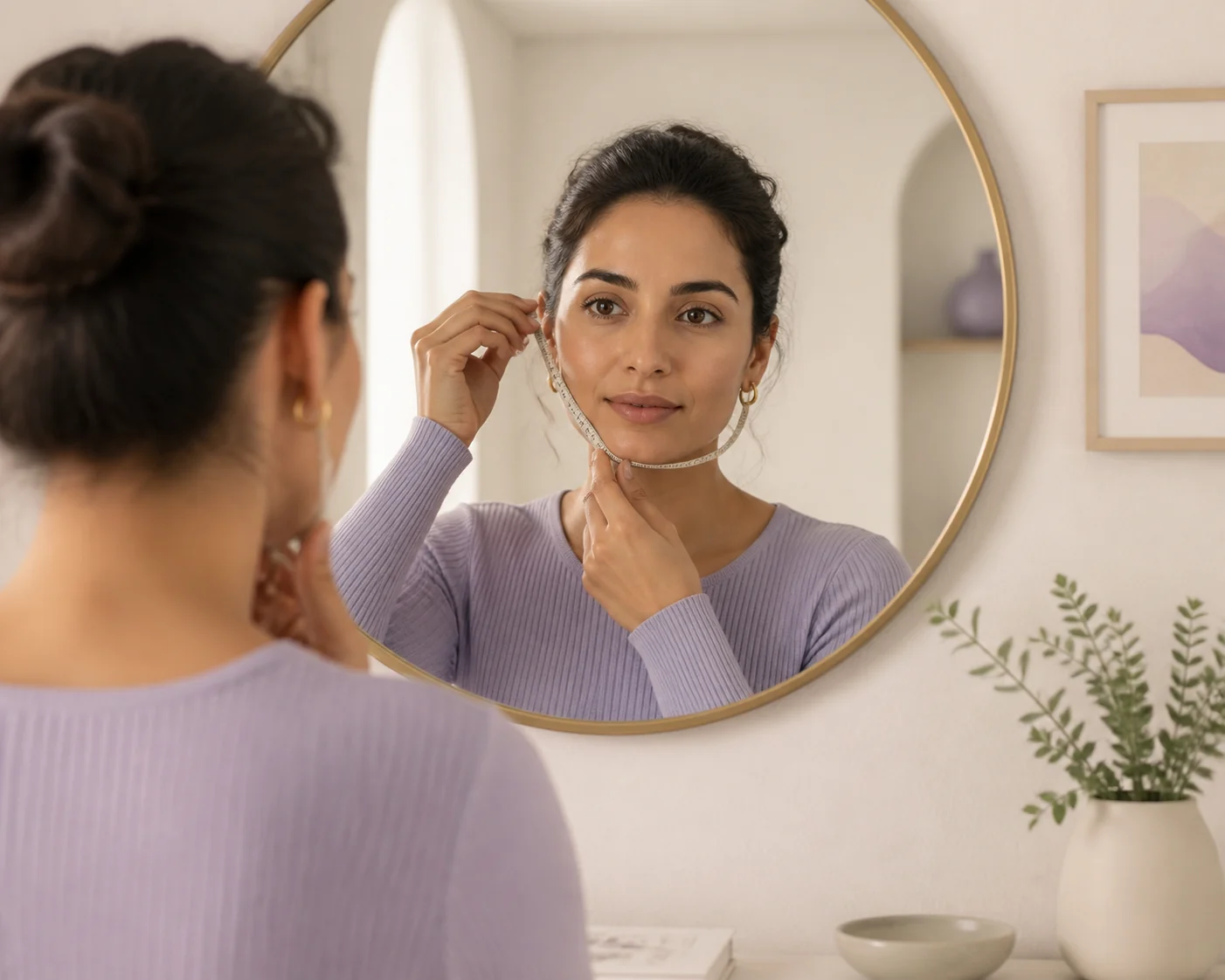
Wondering, “What face shape do I have?” You do not need a perfect diagram or a professional consultation to get a useful first answer.
The most reliable at-home approach combines proportions rather than focusing on one feature. Face length, forehead width, cheekbone width, jawline width, and the way the lower face tapers give you a more stable pattern than hair, makeup, or a single selfie angle.
This guide shows how to find out your face shape in three ways: a quick visual check, a measurement method, and a photo-aware check. Use the methods together when you want to know your face shape with more confidence, especially if you seem to sit between oval, oblong, round, square, heart, diamond, or triangle categories.
The quick way to find your face shape
Start with a mirror and a neutral expression. You are looking for the overall outline, not judging whether one feature is attractive or perfectly symmetrical.
Clear the outline
Pull hair away from your face, remove sunglasses, and stand in even light. Keep your chin level instead of tilting toward the mirror.
Compare length and width
Notice whether your face is clearly longer than it is wide, close to as long as it is wide, or widest around the cheekbones.
Trace the widest area
Compare forehead, cheekbones, and jawline. Ask whether the lower face tapers, stays broad, or looks angular.
Check the jawline
A rounded jaw often supports round or oval impressions; a straighter, more defined jaw can support square, oblong, or heart comparisons.
Use the mirror check as a starting point. Face-shape labels describe broad patterns, so the closest family matters more than forcing every curve into one rigid category.
How to find your face shape with measurements
If you want a repeatable answer, measure four points with a soft tape measure or use a ruler against a front-facing photo. Record the numbers in the same unit and avoid pulling the tape tightly across the skin.
Measure across the widest visible part of the forehead, across the cheekbones, from one jaw angle to the other, and from the top of the hairline to the bottom of the chin. The measurements are clues, not a medical formula; your jaw curve and chin shape still matter.
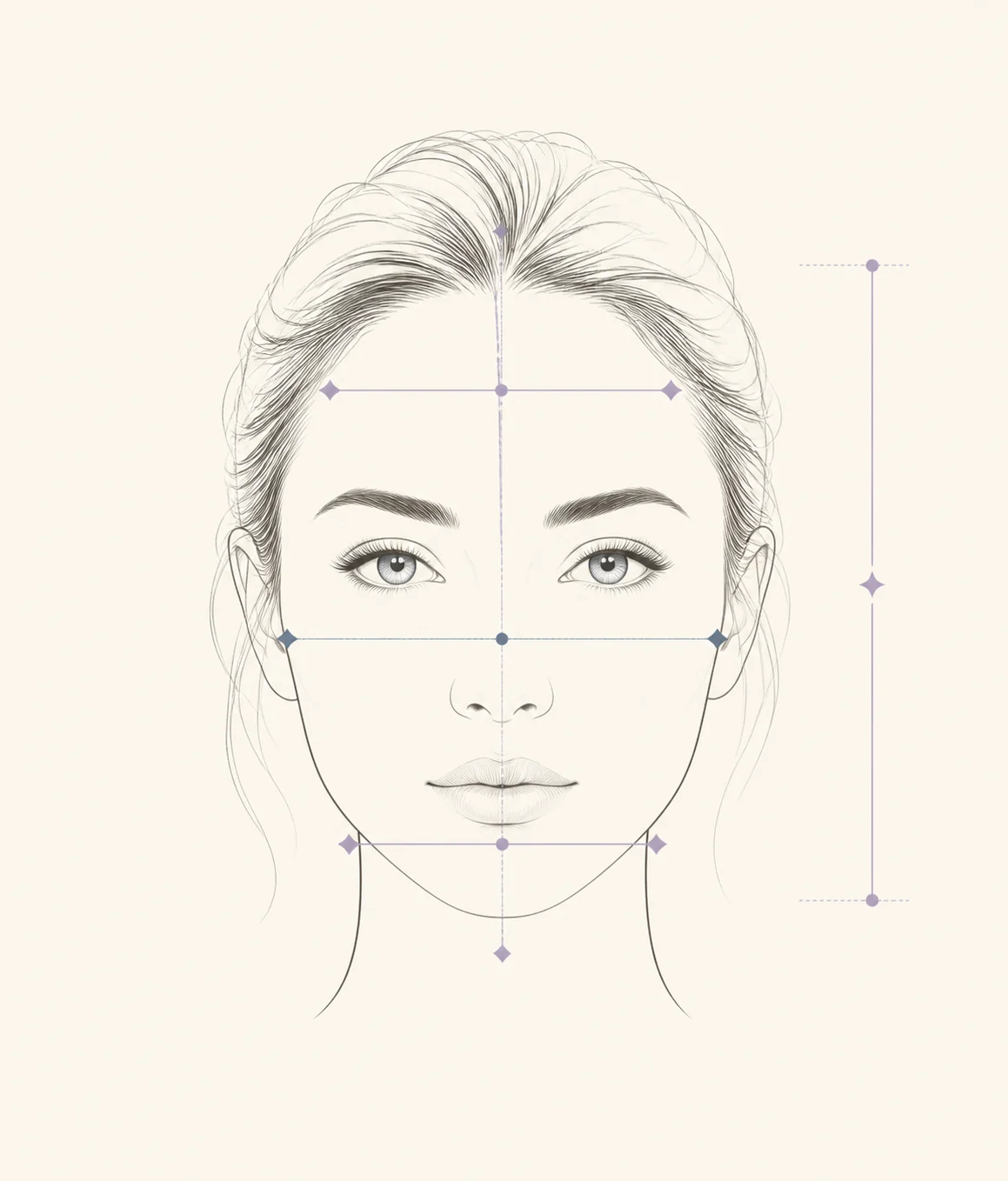
Forehead width
Measure the broadest horizontal distance across the forehead, usually above the eyebrows and below the hairline.
Cheekbone width
Measure from the most prominent point of one cheekbone to the matching point on the other side.
Jawline width
Measure between the jaw angles, or measure one side from the chin to the jaw angle and double it.
Face length
Measure from the center of the hairline to the bottom of the chin with your head level and the camera at eye height.
| What to compare | Pattern that may stand out | Useful question |
|---|---|---|
| Length vs. width | Much longer, similar, or slightly longer | Does my face read long before I notice the jaw? |
| Widest area | Forehead, cheekbones, or lower face | Where does the outline reach its maximum width? |
| Taper | Strong taper, gentle taper, or little taper | Does the face narrow toward the chin? |
| Jaw character | Rounded, softly angled, or straight/angular | Does the jaw look curved or structured? |
| Chin | Narrow, rounded, broad, or pointed | Does the chin reinforce the same pattern? |
Two people can have similar ratios but different face shapes because cheekbone prominence, jaw angles, and chin contours change the outline. Treat measurements as a guide for comparison, not a pass-or-fail test.
Compare your proportions with common face shapes
After measuring, compare the overall pattern with the descriptions below. The “widest area” is often more useful than one exact ratio.
| Face shape | Typical proportion clue | Outline clue | Common overlap |
|---|---|---|---|
| Oval | Face is longer than wide; widths taper gently | Soft jaw and rounded chin | Oblong when length is more pronounced |
| Round | Length and width are relatively close | Full cheeks and a curved jaw | Oval when the face is slightly longer |
| Square | Forehead, cheekbones, and jaw are fairly similar | Straighter sides and a defined jaw | Oblong when the face is longer |
| Heart | Forehead is wider than the jaw | Cheekbones and a narrower or pointed chin | Diamond when cheekbones are the clear widest point |
| Diamond | Cheekbones are the widest area | Narrower forehead and jaw with a defined chin | Heart when the forehead is also broad |
| Oblong | Face is noticeably longer than wide | Longer sides with a relatively even width | Oval or square depending on the jaw |
| Triangle | Jaw is wider than the forehead | Lower face carries the visual weight | Square when the jaw is angular and broad |
If your widest area is clear but the jaw or length points in another direction, describe your result as a blend. For example, “oval with oblong tendencies” is often more accurate than choosing a category that ignores half of the evidence.
How to check your face shape from a photo
A photo can make the comparison easier, but phone cameras can also stretch the center of the face or make the nearest side look wider. Use a recent, straight-on portrait taken from a little farther away rather than a close-up selfie.
Compare more than one image if possible. A neutral expression, hair pulled back, and camera positioned near eye level make the outline easier to read. A side angle is useful for profile features, but it is not the best image for measuring face width.
Use even light
Soft light reduces shadows under the cheekbones and jaw, so the visible outline does not look artificially sharper.
Keep the lens back
A little distance and a normal camera lens usually create less perspective stretch than a very close front-camera photo.
Keep your head level
Tilting or turning changes the apparent width of the jaw and can make one cheek look more prominent.
Compare the silhouette
Focus on the forehead, cheekbones, jaw, and chin outline. Do not let hairstyle, contour makeup, or facial expression decide the result.
A photo-based result is an estimate, not an identity judgment or a clinical measurement. If an image produces a surprising label, retake it under neutral conditions before drawing a conclusion.
Common mistakes when finding your face shape
Many confusing results come from changing the conditions instead of changing the face. A close selfie, a high camera angle, a heavy contour, or hair covering the temples can all change what you see.
When you compare a mirror view with a calculator or AI estimate, remember that each method sees a slightly different outline. Use the disagreement as a prompt to check the photo and measurements, not as proof that one method is broken.
- Choosing a face shape from hairstyle or makeup instead of the underlying outline.
- Using only face length and ignoring forehead, cheekbone, jawline, and chin shape.
- Measuring one side of the face at a different point than the other side.
- Treating normal left-right asymmetry as a separate face-shape category.
- Assuming every face must fit one perfect label with no overlap.
What if you fit two face shapes?
Mixed results are common. Face shapes are descriptive families, not fixed biological boxes, and small changes in length, jaw angle, cheekbone prominence, or chin shape can move a person toward a neighboring category.
If you are between two shapes, write down the two strongest clues and use the label that helps with your practical goal. For glasses or hairstyles, the jaw and cheekbone pattern may matter more than the exact name. For a measurement test, keep the recorded numbers so you can compare them again with a better photo.
A useful answer can be specific without being absolute: “round-to-oval,” “heart with diamond cheekbones,” or “square with oblong length” communicates more than an overconfident single word.
Use a face shape calculator or detector
Once you understand the proportions, an online face shape tool can make the process faster. Our face shape calculator supports manual measurements and a photo mode, while the face shape detector is designed for a quick uploaded-photo estimate.
Choose the calculator when you want to see how forehead, cheekbone, jawline, and face-length inputs affect the result. Choose the detector when you want a fast first pass and an explanation of the facial features behind the match.
- Prepare a clear, front-facing photo with your hair away from the outline.
- Use the photo mode or enter your four measurements in the calculator.
- Read the primary and secondary result together, then compare it with the visual table above.
- Repeat with a better-lit photo if the result does not match the outline you can see in a mirror.
The tools provide educational estimates for face-shape exploration. They do not identify a person and should not be used as medical or psychological assessments.
Frequently asked questions
Further reading
- For a technical overview of facial landmark detection and geometry, see the official MediaPipe Face Landmarker documentation
- For a broader discussion of face image quality and camera conditions, see the NIST Face Recognition Technology Evaluation resources
Last updated: August 18, 2026