
On this page
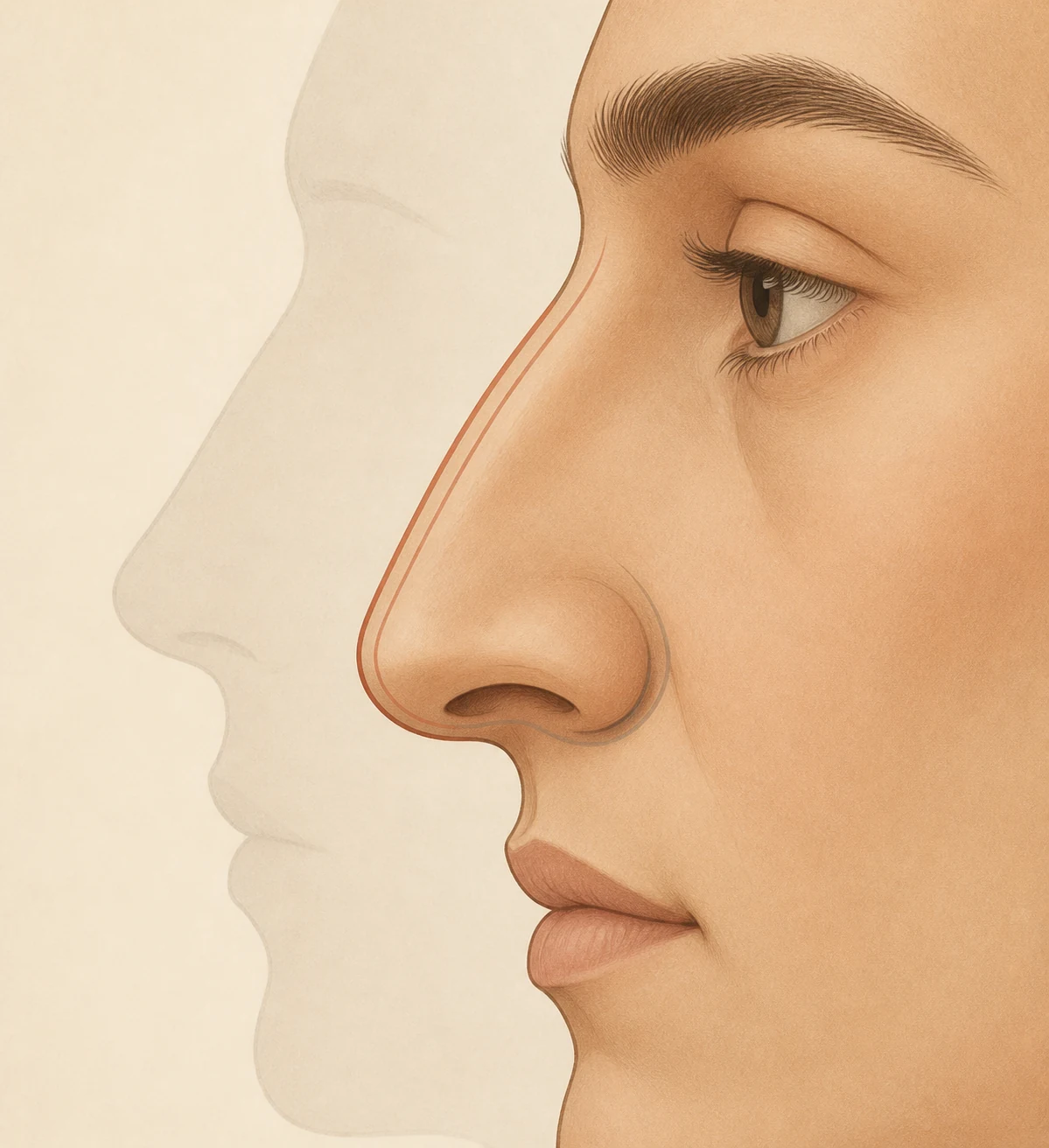
Searches for aquiline nose usually begin with a profile question: does a long bridge curve smoothly like an eagle profile, or is the shape better described as Roman, Greek, straight, or simply prominent? The useful answer is descriptive rather than judgmental. Start with the side profile, separate bridge line from tip direction, and compare more than one neutral photo before choosing a label.
Aquiline nose quick check
Use these clues as a starting point. No single feature can classify every real nose, and natural faces often combine more than one pattern.
| Clue | Often consistent with aquiline | What it does not prove |
|---|---|---|
| Bridge line | A long, smooth outward curve from the upper bridge toward the tip | It does not prove a large hump or a specific ancestry |
| Profile length | The bridge can look elongated or flowing rather than compact | It does not mean the whole nose is large |
| Tip direction | Neutral or slightly downward is common, but the tip can vary | Tip direction alone describes an upturned or downturned trait |
| Front width | Narrow, medium, or broad width may all occur | Aquiline is not a width label |
| Photo test | The same smooth curve appears in several natural side views | One close selfie can exaggerate projection or shorten the bridge |
Think of aquiline as a bridge-profile description. Add separate words for width, tip shape, and nostril visibility instead of forcing one label to explain every feature.
What is an aquiline nose?
An aquiline nose is commonly described as a nose with a long, curved, eagle-like bridge. The curve usually flows across the profile instead of forming one short, abrupt bump. The word comes from the Latin aquila, meaning eagle, so the description refers to the silhouette seen from the side rather than to a fixed size, gender, ethnicity, or personality.
The most useful visual question is whether the bridge creates a continuous arc. A small dip, a smooth outward curve, or a gentle downward tip may all appear in an aquiline profile. Because real noses are not drawn from one template, the curve can be subtle and the rest of the nose can be narrow, full, rounded, or relatively straight in front view.
Profile first
The defining clue is the side silhouette from the root of the nose to the tip, not how the nose looks in one front-facing selfie.
A neutral label
Aquiline is a descriptive shape term. It should not be used as a ranking of attractiveness or as a shortcut for ancestry.
Use aquiline when the long flowing curve is the strongest visible feature. If the strongest feature is a compact, abrupt hump, compare the Roman-nose description as well.
Aquiline vs Roman vs Greek nose
Aquiline and Roman noses overlap because both can have a prominent bridge. In a practical comparison, Roman usually emphasizes a stronger or more abrupt convex hump, while aquiline emphasizes a longer and smoother arc. The boundary is not a medical rule, and a real nose may reasonably fit both descriptions depending on the angle and the feature being discussed.
Greek nose is usually used for a straighter, uninterrupted bridge. A nose can be narrow and Greek-like from the side, or it can be broad with a straight bridge. Width does not decide whether a profile is Greek, Roman, or aquiline; the bridge line is the more useful clue.
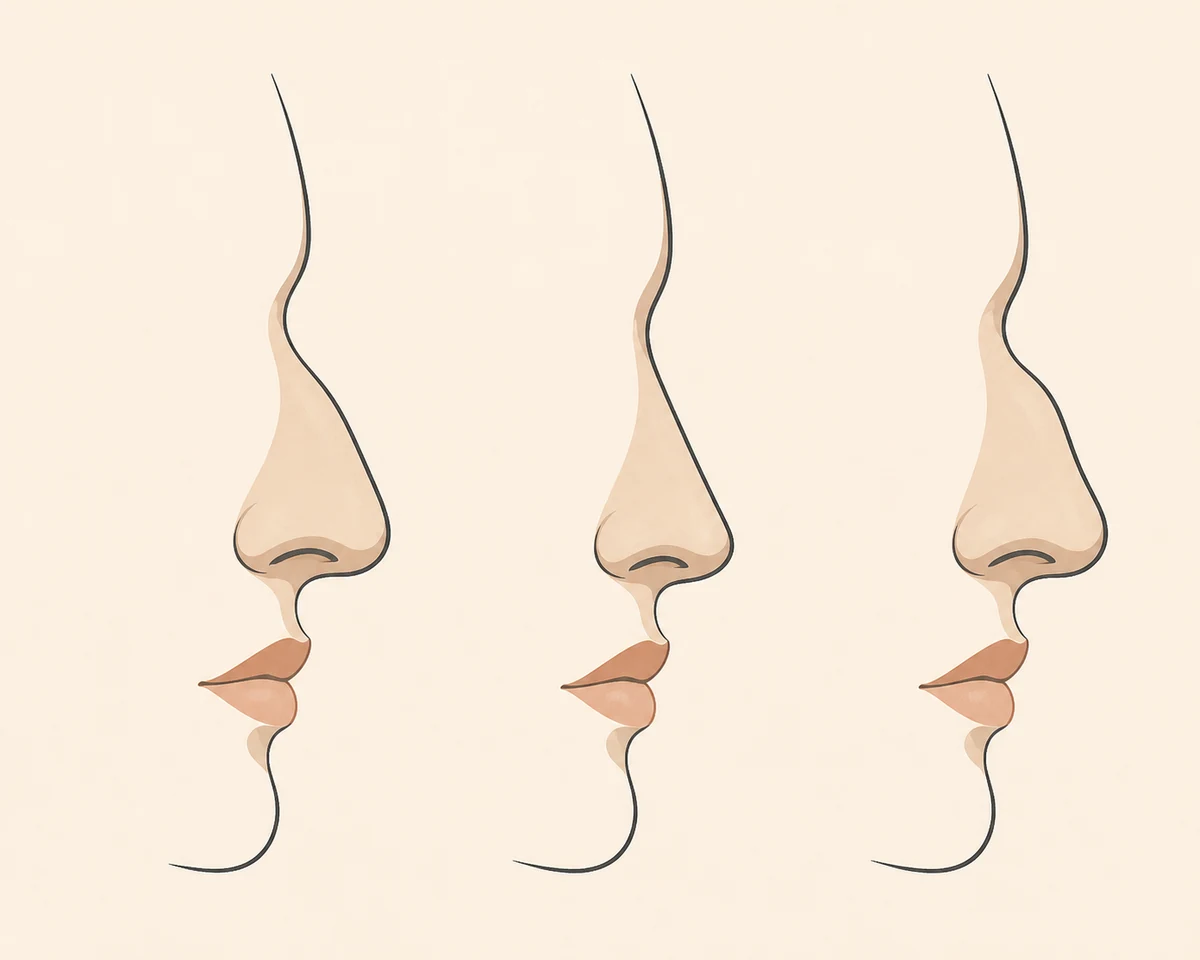
Aquiline
Longer bridge with a graceful outward arc that flows toward the tip.
Roman
More prominent or abrupt convex bridge, often with a visible dorsal hump.
Greek
Straighter, even bridge line with little visible interruption from root to tip.
Mixed profile
A mostly straight upper bridge with a small curve can sit between labels; describe the visible combination.
If the distinction matters for a consultation, use plain feature words such as long curve, hump, bridge height, and tip direction rather than relying on a label alone.
Width, tip shape, and mixed aquiline traits
Aquiline describes the bridge profile, not the width of the nasal base. A person can have an aquiline nose with a narrow, medium, or broad front view. The tip may be rounded, pointed, neutral, or slightly downturned. Looking at these traits separately prevents a common mistake: assuming a long curved bridge must also mean a large or heavy nose.
Front and side views answer different questions. A front view helps you observe width, nostril outline, and tip fullness. A side view shows the bridge curve, projection, and tip direction. Combine them only after checking that the camera distance and angle are reasonably consistent.
Bridge
Record whether the line is straight, smoothly curved, or marked by a shorter hump.
Tip
Note whether the tip is neutral, rounded, pointed, slightly downturned, or visibly lifted.
Base
Describe the nostril base as narrow, medium, or broad without turning width into a value judgment.
A combined description such as long, smoothly curved bridge with a rounded tip is often more accurate than choosing one rigid nose type.
How to check an aquiline nose in photos
Start with a true side-profile photo taken from a normal distance at eye level. Keep the expression relaxed, avoid a strong beauty filter, and use even light. Trace the bridge visually from the root toward the tip. You are looking for the direction and length of the curve, not for a perfect measurement or a dramatic silhouette.
Then compare a three-quarter image and a front image. A close wide-angle selfie can make the center of the face look larger and can change the apparent bridge length. Shadows under the tip can also make a profile look more downturned. Repeat the check with two or three neutral photos before treating aquiline as a stable descriptive label.
Side view
Use it to judge the bridge arc, projection, and tip direction.
Three-quarter view
Use it to see whether the curve remains visible when the face is not perfectly turned sideways.
Front view
Use it to record width and nostril outline, not to replace the profile check.
Photos support an educational self-check, not a diagnosis. Lighting, lens choice, head angle, makeup, and expression can all change the apparent shape.
Styling ideas and the medical boundary
If you are exploring makeup, the goal can be to emphasize or soften the bridge line according to your own preference. A narrow highlight along the center and softly blended shading beside a curve may change the photographed contrast, but makeup does not change the underlying structure. Glasses fit is also practical rather than diagnostic: bridge width, nose pads, frame weight, and adjustment matter more than a label.
Questions about narrowing a nose, reducing a hump, changing breathing, or correcting a recent injury require an in-person assessment. A nose-shape article cannot recommend a procedure or predict a result. Seek a qualified clinician for pain, sudden swelling, breathing changes, trauma, or any surgical decision.
Optional styling
Use contour or highlight as a personal styling choice, not as a correction for a supposedly wrong nose.
Professional advice
Use an ENT or qualified facial-plastic specialist for medical symptoms or procedure-specific questions.
A distinctive profile is a normal facial variation. The label is useful when it improves description, not when it pressures you to change your appearance.
Five-step aquiline nose self-check
Use this short workflow to decide whether aquiline is a useful description for your photos.
- Choose a natural side-profile photo taken from a normal distance, without a heavy filter or strong contour makeup.
- Trace the bridge from the root to the tip and note whether the curve is long and flowing or short and hump-focused.
- Check a three-quarter view to see whether the same profile impression remains when the angle changes.
- Use a front view to record width, tip fullness, and nostril outline as separate traits.
- Write a combined description such as aquiline with a rounded tip, then compare the Roman and Greek guides before using one label with confidence.
The detector is educational and may identify more than one visible characteristic.
Aquiline nose FAQ
References
- Cambridge Dictionary provides the standard English definition of aquiline as an eagle-like nose or profile. Cambridge Dictionary
- Cleveland Clinic provides general information about rhinoplasty and the medical boundary for procedure questions. Cleveland Clinic
Last updated: August 7, 2026